
 CONTACT
(Original Video in Japanese was published on the FINOLAB CHANNEL on June. 23, 2026 by Makoto Shibata) https://youtu.be/vANj5aDSK5c
QR-code payments have become one of the most important innovations in Asia’s digital payment landscape. Although QR codes were originally invented in Japan, their large-scale adoption for consumer payments began in China and has since spread throughout Asia. Today, QR payments are transforming how people make purchases, transfer money, and conduct cross-border transactions.
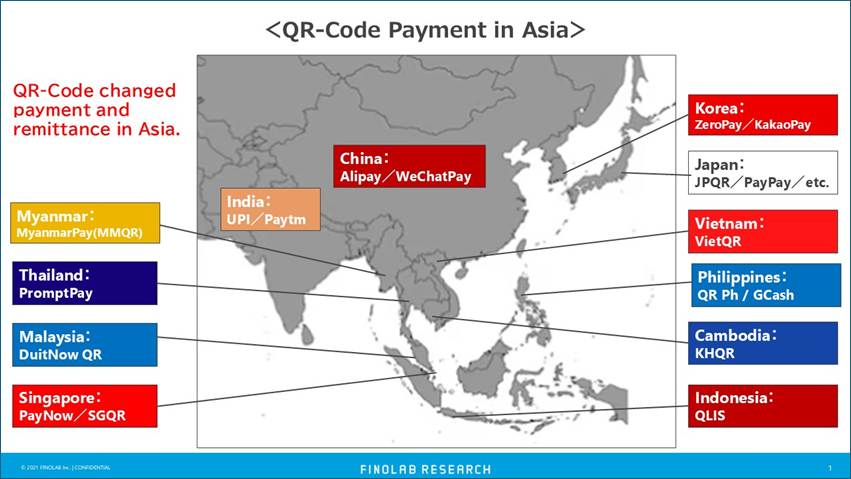
China played a pioneering role through the rapid growth of Alipay and WeChat Pay. Supported by the widespread adoption of smartphones, these services evolved into “super apps” that integrate payments with messaging, e-commerce, transportation, and many other daily activities. Together they dominate China’s mobile payment market and have expanded their usability across many Asian countries.
Other Asian countries have followed different paths but share a common trend: government-led development of real-time payment infrastructure linked to QR-code technology.
India’s Unified Payments Interface (UPI), introduced in 2016, is one of the most successful examples. UPI enables instant transfers and payments through mobile applications, phone numbers, and QR codes. It has become the dominant payment infrastructure in India and is often cited as one of the world’s largest real-time payment systems.
Singapore introduced PayNow for instant payments and later launched SGQR, a unified QR standard that allows multiple payment providers to be accepted through a single QR code. Similarly, Thailand’s PromptPay, Indonesia’s QRIS, Malaysia’s DuitNow QR, the Philippines’ QR Ph, Vietnam’s VietQR, Cambodia’s KHQR, and Myanmar’s MMQR all represent national efforts to standardize QR payments and ensure interoperability among banks, e-wallets, and payment providers.
Japan presents a unique case. Despite being the birthplace of QR-code technology, the country initially experienced fragmentation, with many competing payment services such as PayPay and others. To address this issue, the Cashless Promotion Council introduced JPQR, a unified QR payment standard. More recently, Japan has begun connecting JPQR with overseas systems, including those of Cambodia and Indonesia, improving convenience for international visitors and businesses.
A major trend highlighted in the presentation is the shift from national standardization to international connectivity. Singapore has taken a leadership role by linking PayNow with Thailand’s PromptPay and subsequently connecting with payment systems in India, Malaysia, and Indonesia. Additional links with other ASEAN countries are under development. Meanwhile, Alipay has established partnerships with more than 50 payment providers across Asia, creating a broad network of interoperable QR payment services.
Another emerging development is the integration of stablecoins into QR payment infrastructures. Pilot projects are exploring how stablecoins can serve as the settlement layer behind QR transactions, enabling 24/7 cross-border payments with lower foreign-exchange and transaction costs. Examples include stablecoin payment trials in Japan and initiatives by regional platforms such as Grab.
In conclusion, QR payments have evolved from a simple payment method into a strategic digital infrastructure for Asia. Governments have promoted common standards and interoperability, while cross-border connections are gradually creating a seamless regional payment network. Looking ahead, the combination of QR payments, real-time settlement systems, and stablecoin technology may further accelerate financial integration across Asia.