
[Summary] QR Payments Across Asia: Standardization and Cross-Border Connectivity | FinTech Topics #129

Original Video in Japanese was published on the FINOLAB CHANNEL on June. 23, 2026 by Makoto Shibata https://youtu.be/vANj5aDSK5c

QR-code payments have become one of the most important innovations in Asia’s digital payment landscape. Although QR codes were originally invented in Japan, their large-scale adoption for consumer payments began in China and has since spread throughout Asia. Today, QR payments are transforming how people make purchases, transfer money, and conduct cross-border transactions.
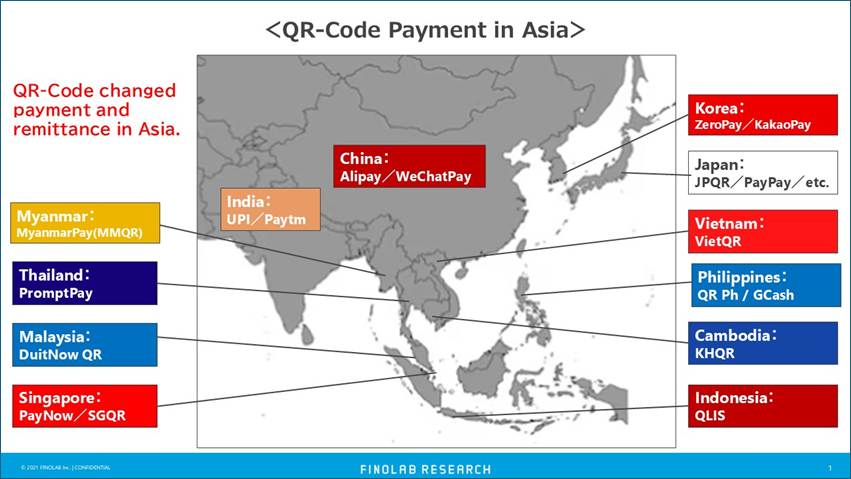
China played a pioneering role through the rapid growth of Alipay and WeChat Pay. Supported by the widespread adoption of smartphones, these services evolved into “super apps” that integrate payments with messaging, e-commerce, transportation, and many other daily activities. Together they dominate China’s mobile payment market and have expanded their usability across many Asian countries.

Other Asian countries have followed different paths but share a common trend: government-led development of real-time payment infrastructure linked to QR-code technology.

India’s Unified Payments Interface (UPI), introduced in 2016, is one of the most successful examples. UPI enables instant transfers and payments through mobile applications, phone numbers, and QR codes. It has become the dominant payment infrastructure in India and is often cited as one of the world’s largest real-time payment systems.

Singapore introduced PayNow for instant payments and later launched SGQR, a unified QR standard that allows multiple payment providers to be accepted through a single QR code. Similarly, Thailand’s PromptPay, Indonesia’s QRIS, Malaysia’s DuitNow QR, the Philippines’ QR Ph, Vietnam’s VietQR, Cambodia’s KHQR, and Myanmar’s MMQR all represent national efforts to standardize QR payments and ensure interoperability among banks, e-wallets, and payment providers.

Japan presents a unique case. Despite being the birthplace of QR-code technology, the country initially experienced fragmentation, with many competing payment services such as PayPay and others. To address this issue, the Cashless Promotion Council introduced JPQR, a unified QR payment standard. More recently, Japan has begun connecting JPQR with overseas systems, including those of Cambodia and Indonesia, improving convenience for international visitors and businesses.

A major trend highlighted in the presentation is the shift from national standardization to international connectivity. Singapore has taken a leadership role by linking PayNow with Thailand’s PromptPay and subsequently connecting with payment systems in India, Malaysia, and Indonesia. Additional links with other ASEAN countries are under development. Meanwhile, Alipay has established partnerships with more than 50 payment providers across Asia, creating a broad network of interoperable QR payment services.

Another emerging development is the integration of stablecoins into QR payment infrastructures. Pilot projects are exploring how stablecoins can serve as the settlement layer behind QR transactions, enabling 24/7 cross-border payments with lower foreign-exchange and transaction costs. Examples include stablecoin payment trials in Japan and initiatives by regional platforms such as Grab.

In conclusion, QR payments have evolved from a simple payment method into a strategic digital infrastructure for Asia. Governments have promoted common standards and interoperability, while cross-border connections are gradually creating a seamless regional payment network. Looking ahead, the combination of QR payments, real-time settlement systems, and stablecoin technology may further accelerate financial integration across Asia.

[Summary] Impact of Japan’s Revised Insurance Business Act on InsurTech and Digital Transformation| FinTech Topics #128

Original Video in Japanese was published on the FINOLAB CHANNEL on May. 19, 2026 by Makoto Shibata https://youtu.be/sHw7NkkiDTg

Japan’s revised Insurance Business Act, which will take effect in June 2026, represents the most significant reform of insurance regulation since 2014. The amendment is designed to address a series of misconduct cases that have undermined trust in the insurance industry and to promote a more customer-centric insurance distribution model. At the same time, the reform is expected to accelerate digital transformation and create substantial opportunities for InsurTech companies.

The regulatory changes were prompted by several high-profile scandals. These included allegations of premium coordination among major non-life insurers, fraudulent insurance claims associated with automobile dealer Big Motor, conflicts of interest within insurance agencies, and incidents involving the unauthorized sharing of customer information by secondees. Collectively, these cases exposed weaknesses in governance, compliance, and customer protection across the insurance sector.

In response, the revised law introduces stronger governance and compliance requirements for large-scale insurance agencies and insurance companies. Major agency groups will be required to appoint compliance officers, establish complaint-handling frameworks, strengthen internal controls, and implement whistleblowing and internal audit systems. Insurance companies will also face enhanced oversight responsibilities when outsourcing sales activities to agencies. Furthermore, the reform prohibits excessive benefits or incentives that could distort fair insurance recommendations.

Perhaps the most important change concerns insurance sales practices. Historically, many agencies recommended products based on their own internal criteria, commission structures, or preferred partnerships with insurers. Under the revised framework, agencies will be expected to recommend products based on customers’ actual needs and interests. They must provide clear explanations of why a particular product was selected, document comparison criteria, and maintain records of the recommendation process. This significantly increases the importance of transparency, accountability, and evidence-based sales practices.

As a result, the insurance industry is likely to undergo several structural shifts. Sales activities will move away from individual salesperson judgment and toward data-driven decision-making. Business models focused primarily on product sales will increasingly evolve into customer-value-centered models. Documentation, auditability, and evidence management will become critical capabilities. In addition, smaller agencies may face increasing compliance burdens, potentially accelerating industry consolidation.

These developments create a favorable environment for InsurTech innovation. Demand is expected to grow for AI-powered comparison and recommendation tools, explainable AI systems, compliance monitoring solutions, and software platforms that manage sales processes and regulatory requirements. Technologies such as eKYC, digital signatures, voice-recording tools, and RegTech solutions will become increasingly important. Embedded insurance models are also expected to expand as insurers seek more efficient and customer-friendly distribution channels.

Several Japanese InsurTech companies are already well positioned to benefit from these trends. Sasuke Financial Lab operates digital insurance comparison services that provide access to products from numerous insurers. Hokan offers SaaS solutions that integrate customer information, policy management, compliance controls, and sales records for insurance agencies. Finatext’s Inspire platform supports digital insurance distribution and embedded insurance services while enabling rapid product deployment and system integration.

In conclusion, the 2026 revision of Japan’s Insurance Business Act is more than a regulatory compliance initiative. It represents a fundamental shift toward customer-centricity, transparency, and operational excellence. As insurers and agencies adapt to these new requirements, digitalization and AI adoption are likely to accelerate. The ability to demonstrate customer benefit and maintain transparent decision-making processes will become a key competitive advantage, creating significant growth opportunities for InsurTech firms and technology providers across the insurance ecosystem.

[Summary] Future of Payment Systems in Japan: From the Study Group Report from Zengin System | FinTech Topics #126

(Original Video in Japanese was published on the FINOLAB CHANNEL on Mar. 31, 2026 by Makoto Shibata)

The study group report on the Future of Payment Systems in Japan was published on Mar. 19, 2026, focusing on the Zengin System, Japan’s core interbank settlement infrastructure. While the Zengin System has long supported reliable bank transfers, it now faces growing pressure to evolve due to rapid changes in the financial landscape.

1. Limitations of the Current System

  • The Zengin System is highly stable but not designed for real-time, 24/7 digital demands.
  • It reflects a legacy structure optimized for traditional banking rather than modern, data-driven finance.

2. Rise of New Payment Needs

  • Increasing demand for instant payments, always-on availability, and seamless user experience.
  • Growth of cashless payments, fintech services, and platform-based economies is reshaping expectations.

3. Competition and External Pressure

  • Non-bank players and fintech companies are introducing more flexible and user-centric payment solutions.
  • Global trends (e.g., real-time payment systems in other countries) highlight the need for Japan to modernize.

4. Direction of Reform

  • The report suggests upgrading infrastructure toward:
    • 24/7 real-time processing
    • Open and interoperable systems
    • Enhanced data utilization (beyond simple fund transfers)
  • Emphasis on collaboration between banks, FinTech companies, and other industries.

5. Strategic Implications

  • Payment systems are no longer just “infrastructure” but a core competitive domain.
  • Future financial services will be built around embedded finance, APIs, and ecosystem integration.

Conclusion

The video concludes that Japan’s payment system must transition from a bank-centered, batch-processing model to a real-time, ecosystem-driven platform.
This transformation is essential not only for maintaining competitiveness but also for enabling innovation in the broader digital economy.

[Summary] Implementation of Enterprise Value Collateral: Expanding Funding Options for Startups | FinTech Topics #125

(Original Video in Japanese was published on the FINOLAB CHANNEL on Feb. 24, 2026 by Makoto Shibata)

On May 25, 2026, Japan will reach a historic milestone in its financial evolution with the enforcement of the “Act on Promotion of Business-Based Financing.” The centerpiece of this legislation is the introduction of “Enterprise Value Collateral Rights”—a new lending framework designed to move away from the traditional reliance on real estate collateral and personal guarantees from business owners.

1. What is “Enterprise Value Collateral”?

Historically, Japanese bank loans have required “tangible assets” such as land or buildings as security. However, the core strengths of modern startups and service industries lie in “intangible assets”—brands, proprietary know-how, and customer bases.

  • Scope of Collateral: This right covers a company’s “total assets.” This includes future assets, intellectual property, business models, and projected cash flows.
  • Evaluation Perspective: Instead of looking solely at past financial statements or real estate appraisals, lenders will evaluate a company’s future potential and growth capacity.
  • The Mechanism: The right is established and registered via a trust agreement. In the event of default, the principle is to pursue a “business transfer” (selling the business as a whole) rather than liquidating individual assets, ensuring business continuity.

2. Why is this Reform Necessary Now?

Japan’s traditional financial system has faced long-standing criticism for two main reasons:

  1. Limited Growth Support: Even high-growth companies were often unable to secure sufficient loans because they lacked physical collateral.
  2. Rigid Supply of Capital: It was difficult to provide capital flexibly for critical stages such as business succession or corporate restructuring.

Under the new system, if a business can prove its future viability, it is expected that the flow of “risk money” will improve across all phases: from founding and growth to turnaround.

3. Benefits for Startups: The Coexistence of Debt and Equity

For startups—particularly those between Series A and Series B rounds—this system serves as a powerful new tool.

  • Preventing Equity Dilution: Previously, founders were forced to rely almost entirely on Venture Capital (equity), often leading to excessive dilution of their ownership. Now, “Bank Loans (Debt)” become a viable alternative.
  • Lending Possible Despite Deficits: For SaaS companies that are in the red due to heavy upfront investment, banks can now provide growth capital if they can verify healthy KPIs, such as low Churn Rates or high LTV (Lifetime Value).
  • Clearer Role Division: A synergy will emerge where VCs provide “aggressive risk money” for high-stakes bets, while banks provide “stable growth capital” based on business value.

4. The Challenge of “Advanced Discernment”

For this system to succeed, several hurdles must be overcome:

  • Establishing Evaluation Models: Determining who measures business value and how is critical. There is an urgent need for specialists and models capable of judging market growth and human capital.
  • Monitoring Burden: Startups will be required to maintain transparent KPI management and actively disclose both financial and non-financial information.
  • Regional Bank Capabilities: A major focus will be whether regional banks, which may have limited specialized personnel, can effectively step into this advanced form of credit judgment.

5. Case Studies: Pioneers of Venture Debt in Japan

While the formal introduction of the “Enterprise Value Collateral” system is set for 2026, several forward-thinking financial institutions and startups are already paving the way. By utilizing creative debt structures, these players are providing vital capital to startups that have traditionally been overlooked.

  • Aozora Bank: A true pioneer in the space, Aozora has a long-standing history of actively promoting debt financing for venture companies, leveraging internal expertise to evaluate high-growth potential where others saw only risk.
  • UPSIDER & Mizuho Bank: One of the most notable recent developments is the “UPSIDER Blue Dream Fund.” This collaboration combines the speed of a fintech startup with the capital strength of a megabank, creating a fund specialized specifically in venture debt.
  • Flex Capital (Fivot): As a representative of fintech-led lending, Flex Capital provides data-driven venture debt. They offer a flexible alternative to equity financing, allowing founders to fuel growth without immediate dilution.
  • Siiibo Securities: In a clever use of existing financial instruments, Siiibo enables startups to raise what is essentially venture debt by issuing corporate bonds via private placement. This demonstrates how existing systems can be innovated to create new pathways for capital.

Summary: A System that Tests the “Power of Belief” in the Japanese Economy

The introduction of Enterprise Value Collateral is more than just a new loan product. It is a system that tests how much Japan’s indirect financial sector can truly “believe in” and support the future potential of its companies.

If banks can accurately evaluate the growth margins of startups and deepen their relationships, the Japanese economy stands a real chance of returning to a path of powerful, sustained growth.