(Original Video in Japanese was published on the FINOLAB CHANNEL on Sep. 16, 2025 by Makoto Shibata)
In this article, we’ll break down the Financial Administration Policy for the 2025 business year, announced by Japan’s Financial Services Agency (FSA), with a special focus on key fintech-related measures.
A New Direction: Leveraging Digital Tech to Address Structural Issues
The FSA’s policy emphasizes encouraging financial institutions to “take on the challenge of leveraging innovative technology,” particularly with the rapid rise of generative AI. At the same time, the FSA acknowledges structural issues like a shrinking population and aging society, aiming to balance user protection with financial system stability.
The policy highlights three key priorities: “Contributing to the sustainable growth of financial institutions,” “Ensuring the stability and integrity of the financial system,” and “Building an organization that constantly evolves to serve the public.” A recurring theme is the continuous focus on “adapting to the transformation of financial services through digital technology.”
Key Fintech Action Plans
The Administration Policy outlines several key action plans related to fintech:
1. Crypto Assets and Stablecoins
Recognizing the growing activity in this space globally, the FSA views crypto assets and stablecoins as key drivers of innovation in financial services.
User Protection: The policy calls for necessary institutional reforms to protect investors while promoting innovation.
Tax Reform: The FSA is moving toward a serious discussion on taxing crypto assets with “separate taxation,” similar to other financial products.
Enhanced Supervision: The FSA plans to strengthen its oversight of unregistered firms and establish a regulatory framework for Japanese yen-pegged stablecoins.
2. Support for AI and Fintech
AI Discussion: The FSA will launch a public-private AI forum based on its “AI Discussion Paper” to address practical challenges in the field.
Continued Support: Existing initiatives like “Japan Fintech Week,” the Fintech Support Desk, and the Fintech Sandbox will continue to be promoted.
3. Startup Support and Corporate Value Enhancement
In its push to make Japan a leading nation for asset management, the FSA has included measures to strengthen capital supply for startups.
Venture Capital: The policy aims to make venture capital a more attractive investment and will follow up on a 2024 report that outlined recommended actions for VCs.
Collaboration with the TSE: The FSA will work with the Tokyo Stock Exchange (TSE) to enhance support for companies before and after they list on the Growth Market.
Creating a Better Investment Environment: The FSA is exploring new frameworks, such as allowing unlisted stocks to be included in investment trusts, to expand venture investment opportunities.
4. Strengthening Risk Management
Measures to combat money laundering (AML) and cyberattacks are a high priority.
AML/CFT: The FSA will work to improve its anti-money laundering and counter-terrorist financing measures in preparation for the fifth round of mutual evaluations by the FATF.
Cybersecurity: The policy emphasizes the need to recognize cyber risk not just for financial institutions, but also for their outsourced partners.
Financial Crime: The FSA will work to strengthen its comprehensive measures against financial crimes, such as scams and fraudulent access to securities accounts.
Conclusion
The 2025 Administration Policy clearly shows the FSA’s commitment to embracing new technologies like generative AI and stablecoins while also strengthening the foundations of Japan’s financial infrastructure through startup support and robust risk management. Fintech companies should closely monitor these regulatory trends, as they will have a significant impact on future business development.
(Original Video in Japanese was published on the FINOLAB CHANNEL on Aug. 28, 2025 by Makoto Shibata)
The FINOLAB CHANNEL’s FintechTopics #119 video discusses the latest global stablecoin developments, particularly regulatory progress in the United States, Hong Kong, and Japan, defining stablecoins and explaining their impact on financial markets.
Stablecoin Definition and Background
Stablecoins are crypto assets that, unlike other volatile cryptocurrencies, typically maintain a 1:1 value peg to a fiat currency (such as the US dollar) and are backed by liquid assets like fiat currency, short-term government bonds, or central bank deposits. Historically, there have been cases like Terra, where a stablecoin collapsed due to a significant drop in the price of its underlying crypto asset. Therefore, new regulations explicitly define that stablecoins must be backed by stable assets like fiat currencies or government bonds, not by other unstable crypto assets.
US Stablecoin Regulationl (Genius Act)
The US legislation regarding stablecoins, known as the “Genius Act,” was passed by the Senate on June 17th and by the House of Representatives on July 17th, subsequently signed by the President, officially becoming law.
• Definition and Classification: The act clearly defines stablecoins as digital assets whose value is backed by stable liquid assets such as fiat currencies (e.g., US dollar), US short-term government bonds, or central bank deposits, and which can be redeemed at par value. It explicitly states that stablecoins are not securities, deposits, or bank liabilities.
• Issuer Qualification: Only authorized issuers are permitted to issue stablecoins. These include financial institutions covered by deposit insurance and licensed by the Office of the Comptroller of the Currency (OCC) (such as banks and credit unions), federally licensed non-bank issuers, and state-licensed issuers certified by the Treasury Secretary as meeting federal standards. Foreign issuers may also be approved if they are supervised under a regulatory framework equivalent to that of the US and agree in writing to comply with US regulations.
• Prudential Standards:
◦ Issuers must hold full reserves, meaning they must maintain reserves consisting of deposits or US short-term government bonds equal to the value of all issued stablecoins.
◦ Clear redemption methods must be published, and the monthly composition of reserves must be disclosed.
◦ Re-collateralization (issuing new stablecoins backed by other stablecoins) is prohibited.
◦ False reporting on reserve obligations is subject to criminal penalties.
◦ Issuers must adhere to regulatory standards regarding capital, liquidity, and operational risk, and establish systems for anti-money laundering (AML) checks and sanctions screening.
◦ In the event of bankruptcy, stablecoin holders are granted the highest priority claim on reserve assets.
• Regulation and Supervision:
◦ Scaled regulation is implemented: Issuers of stablecoins exceeding $10 billion in circulation are subject to mandatory federal supervision. Issuers below $10 billion may choose state-level supervision, but state regulations must be certified by the Treasury Secretary.
◦ Regulatory agencies are determined by the issuer type: national banks are regulated by the OCC, state member banks by the Federal Reserve (FRB), state non-member banks by the Federal Deposit Insurance Corporation (FDIC), credit unions by NCIA, and all non-bank issuers are regulated by the OCC.
• Impact on the Market:
◦ The act is expected to increase demand for US Treasury bonds, as regulations require stablecoin reserves to include short-term government bonds. Currently, the two largest stablecoin issuers, Tether and Circle, already hold substantial amounts of US short-term government bonds (Tether around $125 billion, Circle around $55.2 billion), indicating their actions significantly influence the supply and demand in the US Treasury market.
◦ Major banks such as Goldman Sachs, JPMorgan, Citi, and Bank of America have expressed their intention to enter the stablecoin market following the enactment of this law.
◦ The proliferation of stablecoins is expected to enhance the US dollar’s status and presence in international financial markets and settlements.
◦ The act effectively “ratifies” existing stablecoins (like USDT, USDC), and their circulation is expected to continue growing. Some believe that stablecoins could become a de facto alternative to a US Central Bank Digital Currency (CBDC), thereby maintaining the dollar’s dominance in the decentralized finance (DeFi) sector.
Hong Kong Stablecoin Bill
Hong Kong’s stablecoin bill was passed in May and came into effect on August 1st.
• Regulatory Framework: The Hong Kong Monetary Authority (HKMA) has established a dedicated website to explain the implementation details. Hong Kong aims to distinguish its relatively flexible crypto asset policy from mainland China’s digital yuan (CBDC) operations to maintain its status as an international financial hub.
• Applicable Scope and Definition: The act targets stablecoins pegged to fiat currency, termed “Fiat-referenced Stablecoins” (FRS). A license is required for stablecoins issued within Hong Kong or those issued abroad but offered to Hong Kong residents. Providing services or engaging in marketing activities to Hong Kong without a license is prohibited.
• Licensing Requirements:
◦ Reserves and Redemption: Full asset backing, clear redemption procedures, and segregated management of customer assets are required (similar to the US).
◦ Capital Requirements: A minimum paid-up capital equivalent to HKD 25 million must be maintained.
◦ Risk Management and Governance: A three-lines-of-defense framework involving directors and executives, internal controls, oversight systems, credit/liquidity risk management, and stress testing must be established, meeting the risk management standards of financial institutions.
◦ AML/CTF: Robust anti-money laundering and counter-terrorist financing measures must be implemented in accordance with HKMA guidelines.
◦ Service Recipient Restrictions: After obtaining a license, services are primarily directed at institutional investors, with only limited access for individual investors.
• Goals and Current Status: The Hong Kong government aims to promote Web3 and cross-border payments based on the principle of “same activity, same risk, same regulation,” while balancing financial stability. This is considered leading legislation in Asia, aligning with the EU’s MiCA and US laws. Currently, no institutions have yet received licenses, and the HKMA anticipates issuing the first licenses early next year, showing caution towards market exuberance.
Japan’s Stablecoin Developments
Japan revised its Payment Services Act in 2020, implementing it the following year to legally define stablecoins.
• Recent Progress: On August 18, 2025, JPYC announced it had obtained registration as a money transfer business, with plans to issue a Japanese yen stablecoin within the year. This will be the first JPY stablecoin to enter the market.
• Expected Benefits:
◦ Positive Impact on the Japanese Government Bond (JGB) Market: As the issuance of JPY stablecoins increases, their reserves may require the purchase of JGBs, potentially increasing bond liquidity and affecting interest rates.
◦ Strengthened Domestic Remittance and Settlement Infrastructure: The introduction of JPY stablecoins will enable anytime, anywhere settlements and remittances via blockchain, significantly reducing the time and cost associated with traditional bank transfers.
◦ Promotion of Digital Finance Innovation: JPYC plans to issue on chains like Ethereum, Avalanche, and Polygon, supporting Web3 and programmable settlements driven by smart contracts. This will enable new features such as conditional automated settlements and automated recurring payments that were previously difficult to automate.
◦ Enhanced International Presence of the Japanese Yen: The emergence of JPY stablecoins is expected to increase the use of the Japanese yen in international transactions, boosting its international presence.
Conclusion
Globally, stablecoin regulatory frameworks are rapidly evolving, with countries striving to balance financial innovation and stability. The legislative and issuance practices in the US, Hong Kong, and Japan indicate that stablecoins will play an increasingly important role in the future international financial system, potentially transforming traditional financial landscapes and payment methods.
(Original Video in Japanese was published on the FINOLAB CHANNEL on Jul. 15, 2025 by Makoto Shibata)
As the fintech industry continues to evolve, a new question is gaining prominence in Japan: when does an advance payment service cross the line and become a regulated money lending activity under the Money Lending Business Act? In this article, this complex issue is broken down using recent discussions, regulatory updates, and illustrative case studies.
What Are “Advance Payment Services”?
Advance payment services involve a third-party provider making a payment on behalf of a user, with the expectation of reimbursement later. Examples include:
Salary advance services
Bill payment proxy services (e.g. for phone or utility bills)
Buy Now Pay Later (BNPL) models
Business payment platforms
The key regulatory question: Do such services legally count as “lending”?
Why Is This Now a Regulatory Focus?
The surge in new fintech models—particularly in e-commerce and digital payment ecosystems—has blurred the lines between payment facilitation and lending. This has led to:
Ambiguity in legal interpretation: It’s often unclear if such services fall under lending regulations.
Increased regulatory inquiries: The Financial Services Agency (FSA) of Japan has received more queries, prompting clarification through working groups and public guidance.
Innovation outpacing legal framework: New business models often don’t fit existing definitions, creating gray areas that need clarification.
Regulatory Clarification from the FSA
In April 2025, the FSA released a Q&A on Advance Payment Services and Their Applicability to Lending Regulations, following discussions within the Financial System Council.
Key criteria introduced:
Economic Substance Over Form If the transaction has the same economic impact as a loan, it may be considered lending, regardless of contract terms.
Professional Intent If the service is offered continuously and intentionally, it may be considered a “business” under the law.
Profit Motive and Scope Services aren’t automatically exempt just because they don’t target the general public or charge fees.
Exemptions Certain activities by banks or specific business operators under other laws may be excluded.
Two Key Evaluation Axes
When judging whether a service constitutes lending, two key factors are considered:
Creditworthiness Assessment: Does the provider assess the user’s ability to repay or base conditions (fees, limits) on credit scores?
Financial Risk Transfer: Is there substantial risk transferred to the provider, or is the reimbursement nearly guaranteed?
Case Studies: Lending or Not?
The FSA provided real-world examples:
Salary Advance Services → Not Lending
Based on actual work performed
Employer, not employee, bears service fee
No repayment obligation for employees
Short-term and limited in scope
Medical Expense Advance During School Trips → Not Lending
Small, limited scope
No credit scoring
Repayment only of actual cost, not profit-based
Freelancer Bill Payment Proxy with Monthly Repayment → Considered Lending
Users repay with fees
Risk assessed based on income
Operates on a recurring basis
Requires registration under lending laws
Employer Payroll Payment Agency → Not Lending
Implications for Fintech Innovators
Acts as part of payroll processing
No interest, no credit judgment
No repayment by employees
As interest rates rise and new services proliferate, clarity around whether a business model constitutes lending is more important than ever. The FSA’s recent actions show that regulators are becoming more proactive, offering frameworks and case-based interpretations to support innovation while maintaining consumer protection.
For entrepreneurs and developers, understanding these boundaries is crucial to designing compliant services from the start.
Final Thoughts
Advance payment services are now a hot topic in fintech compliance. The FSA has laid the groundwork for clearer interpretation, focusing on credit evaluation and economic substance. Going forward, these frameworks will help innovators navigate legal risk while contributing to a more sophisticated financial ecosystem.
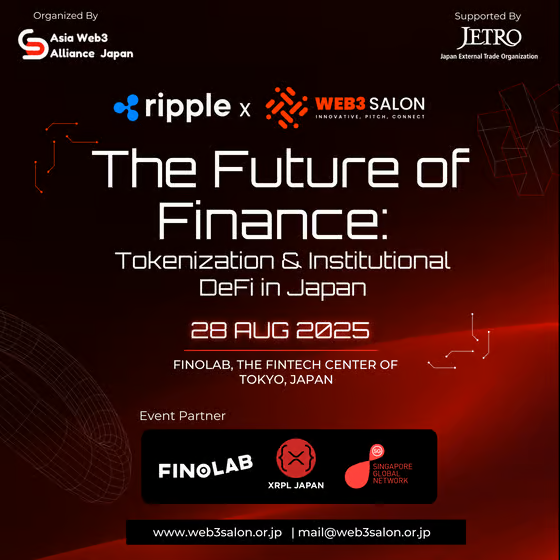
Join Ripple and Web3Salon Supported by JETRO (Japan External Trade Organization) and partnered with FINOLAB, Tokyo for an exclusive side event during WebX Tokyo 2025, bringing together innovators, founders, corporate leaders, and investors shaping the next era of finance. This half-day session brings together leading voices to explore how tokenization and institutional DeFi are reshaping the global financial stack, with a spotlight on Japan’s unique position in the ecosystem.
Whether you’re a builder, founder, investor, or policymaker, this is your chance to explore XRP Ledger (XRPL), understand institutional DeFi use cases, and connect with top fintech startups and stakeholders.
Who Should Attend
Fintech Startup Founders
Corporate Professionals in Digital Assets/Finance
Fintech & Digital Asset VCs Capacity: 100 participants (Register early to secure your spot)
Introduction to JETRO’s upcoming startup support program
Welcome note from Ripple on the future of tokenization and institutional-grade finance
Vision framing: “From crypto-native tools to global financial infrastructure”
3:20 PM – 3:35 PM Ripple Presentation: “Introduction to Ripple and the XRPL Grants Program” Learn about Ripple’s mission, the products powering institutional DeFi, and how XRPL is enabling global financial innovation.
Explore XRPL Grants: opportunities, structure, and builder support.
3:35 PM – 4:00 PM XRPL Technology Workshop for Fintech Startups Hosted by Tequ Discover how easy it is to build financial products on XRPL.
Step-by-step demo: Launching on XRPL
Tools, SDKs, APIs overview
Benefits of XRPL: speed, scalability, compliance, and energy efficiency
Developer support and grants
4:00 PM – 4:45 PM Panel Discussion: “The Future of Finance: Tokenization & Institutional DeFi in Japan” Explore Japan’s leadership in RWA tokenization and institutional blockchain infrastructure. Key Themes:
Institutional DeFi and its adoption timeline
Real-world asset (RWA) tokenization for enterprises
Regulatory and compliance insights (public vs. private chains)
How Japan is shaping the tokenized finance future Moderator: Mai, XRPL Japan | Web3Salon Suggested Panelists: TBA
(Original Video in Japanese was published on the FINOLAB CHANNEL on Jun. 24, 2025 by Makoto Shibata)
Since March 2025, Japan’s online securities industry has seen a rapid increase in unauthorized access incidents. Large-scale and automated attacks have targeted multiple securities companies, pushing the entire industry to respond.
The Reality of the Attacks: Over 17 Companies Targeted, Stock Manipulation Tactics Involved
While initially limited, incidents expanded rapidly by the end of May, affecting over 17 companies. Attackers have been selling customer-owned stocks and using the proceeds to purchase low-liquidity, small-cap stocks—primarily in China and Japan—in large volumes. These tactics are believed to be a form of market manipulation: perpetrators pre-purchase small-cap stocks, artificially inflate their prices, and then sell them for a profit.
Attack Methods: From Phishing to Sophisticated AI-Powered Malware
The attackers have employed several methods:
Highly convincing phishing sites and emails mimicking real securities firms
Info-stealer malware that extracts login credentials from infected devices
Adversary-in-the-middle (AiTM) attacks that intercept session data and bypass multi-factor authentication (MFA)
These threats are compounded by poor password practices and low security awareness among users, such as reusing passwords or clicking on suspicious links.
Industry Issues: Lagging Security Measures and Balancing User Convenience
The securities industry has been criticized for delayed implementation of MFA and maintaining multiple vulnerable login pathways (e.g., PC, mobile apps, third-party integrations). A strong focus on user convenience has often taken priority over security measures, making the systems more exploitable.
What’s Being Done: Industry-Wide Compensation and Strengthened Security
In May 2025, the Japan Securities Dealers Association announced that major online brokerages would offer compensation for losses due to phishing scams, regardless of existing terms and conditions.
Key initiatives include:
Mandatory MFA (via One Time Password(OTP), SMS, smartphone app, or phone callback)
Real-time transaction monitoring and alerting
Swift freezing of compromised accounts
Shared industry blacklists and incident intelligence
Conclusion: A Dual Response from Users and the Industry is Critical
These incidents show that relying solely on ID and password-based logins is no longer viable. Enhancing users’ security awareness and upgrading system-wide defenses are both essential.
Overview: CONSENSUS 2025, one of the world’s largest global conferences for Web3 and crypto, was held in Toronto, Canada from May 14 to May 16, 2025. FINOLAB has participated in this conference for three consecutive years (2023–2025) to keep a consistent pulse on the evolution of blockchain, crypto, and Web3 technologies.
In this in-person event, members from FINOLAB and guest speakers will share insights and key trends observed at CONSENSUS 2025. The session will include individual presentations and a panel discussion focused on one of the conference’s central themes this year: Stablecoins.
For those who find it difficult to attend international conferences, this session offers a great opportunity to catch up on global developments and apply them to your own Web3 strategies.
Venue: FINOLAB 4F Event Space Map & Info Otemachi Building 4F, 1-6-1 Otemachi, Chiyoda-ku, Tokyo Note: Reception is located on the east end, near Tokyo Station
(Original article in Japanese was published for FinTech Journal on Apr. 23, 2025) https://www.sbbit.jp/article/fj/161696 Author: Makoto Shibata, Head of FINOLAB
With the rise of generative AI, financial crimes are becoming more sophisticated and harder to detect. In response, Japan is updating its regulations, including key changes to the Act on Prevention of Transfer of Criminal Proceeds, to better prevent fraud. This article highlights the growing threats and how we can prepare for them.
Overview of AI-Driven Financial Crime Trends
This article focuses on:
Three phishing-related crime methods
Three deepfake case studies
Six key countermeasures to protect against evolving fraud
Key Legal Changes and Implications for Fintech
In February 2025, Japan’s National Police Agency announced revisions to anti-money laundering laws, set to take effect in April 2027. Key changes include:
Individual Identity Verification: Online ID checks using selfies and ID photos will be discontinued. The system will move to using the My Number card’s electronic authentication.
Corporate Verification: Copies of ID documents will no longer be accepted. Originals are now required.
Alternatives for Those Without IC-enabled IDs: Documents like resident records must be submitted by mail.
These changes are a response to how AI can now create convincing fake videos (deepfakes) from a single image, making current identity verification methods unreliable.
3 Key Trends in Phishing Attacks
Phishing cases are increasing, with AI making scams more convincing and widespread. Here are three notable trends:
Voice Phishing (Vishing): AI-generated voice messages pretend to be from agencies like Japan’s Financial Services Agency, tricking people into sharing personal and banking details.
SMS Phishing (Smishing): Fake texts from delivery companies or telecom providers ask users to click links and input banking info.
Targeting Corporations: Scammers now also target businesses with fake calls and emails, leading victims to enter corporate banking credentials on fraudulent websites.
These tactics have caused major losses, including a high-profile case involving Yamagata Bank with possible damages of 1 billion yen.
3 Deepfake-Related Crime Cases
Criminals are using AI-generated images and videos to commit fraud. Here are three real cases:
Hong Kong (2024): A company lost 200 Million HK Dollar after scammers used a deepfake video call to impersonate its CFO and request a money transfer.
Georgia (2024): Deepfakes of celebrities were used in fake crypto ads, scamming over 6,000 victims out of 27 Million Pound.
UK (2024): A romance scam using deepfake videos led to a 77-year-old victim losing over 17 Thousand Pound.
6 Measures to Combat Evolving Financial Crimes
To protect against these increasingly sophisticated threats, both tech and human-focused measures are essential:
Use of deepfake detection tools
Adoption of multi-factor authentication (MFA)
Multi-step approval processes for transactions
Regular employee training
Promoting skepticism toward impersonation
Establishing clear incident response protocols
As technology evolves, criminals adapt quickly. Businesses must continuously review and strengthen their security measures to stay ahead.
The Investment and Development Agency of Latvia, accompanied by Latvian Minister of Economics, Viktors Valainis, and the Director of the Investment and Development Agency of Latvia, Ieva Jāgere, will hold an event in Tokyo at FINOLAB, a leading fintech center in Japan, on May 19 (Monday).
The event will feature the Latvian Minister and accompanying delegates from the Latvian fintech industry, including representatives from “FINTECH LATVIA,” the Latvian Blockchain Association, and various fintech-related organizations in Latvia.
Latvia: A Nordic Country Leading Social Transformation through Public-Private Collaboration
Latvia, a small country with a population of 1.9 million located in the center of the Nordic and Baltic countries, has been promoting advanced social transformation through public-private collaboration. This includes initiatives like establishing the world’s first startup law, advancing digital and data-driven social change led by the government, and effectively leveraging private sector initiatives as public services. Latvia has been at the forefront of developing infrastructure for 5G technology in Europe, driving digital transformation (DX), and leading international cooperation frameworks.
Latvia: A Key Destination for Global Business Services (GBS) Essential for Startup Scale-ups
The capital city of Riga has historically played an important role as a hub for global trade and culture, dating back to the Hanseatic League and the Imperial Era. In recent years, its significance has increased due to globalization, particularly in the area of Global Business Services (GBS), which provides a one-stop framework for services such as language support, legal, tax, HR, and customer services across the region. Latvia has become a key destination for startups, particularly in Europe and EU-adjacent countries, offering low-cost, high-quality services essential for businesses to comply with local regulations and secure talent.
Latvia: A Pioneer in the Introduction of the MiCA License for the Crypto Asset Market in the EU
Latvia was one of the first EU member states to introduce the MiCA (Markets in Crypto-Assets) license for crypto asset operations. The cost of obtaining and maintaining this license is among the lowest in the EU. Many major fintech companies have recognized the high value of establishing operations in Latvia to benefit from the MiCA license and are relocating or establishing offices in the country. Additionally, the Latvian Central Bank provides a regulatory sandbox that allows emerging companies and project teams to cooperate with the bank and develop new business models and services before entering the financial market or expanding their operations in the EU.
During this event, we will introduce the MiCA regulation, Latvian government incentives for fintech companies, and offer opportunities for networking between Latvian and Japanese companies. We look forward to your participation.
◆Venue :FINOLAB Event Space Otemachi Bldg 4F, Otemachi 1-6-1 , Chiyoda, Tokyo, 100-0004 Japan
◆Participation Fee:Free
◆Agenda
17:45-18:00 Reception 18:00-18:20 FINOLAB: Welcome and Introduction of the Business 18:20-18:25 Greeting from the Investment and Development Agency of Latvia 18:25-18:40 FINTECH LATVIA: Introduction to the Latvian Fintech Industry and Business Opportunities 18:40-18:55 LATVIA BLOCKCHAIN ASSOCIATION: Presentation of Business and Support Activities 18:55-19:15 Pitch Session from Latvian Fintech and IT Companies 19:15-20:30 Networking
*The main language will be English, but simultaneous translation will be available for the networking session in both Japanese and English.
*Light refreshments will be provided during the networking session.
※Regarding Photos and Videos This event may include photo and video recording, which may be published on media websites and platforms such as YouTube. If you are concerned about your face or voice being published online, please inform the staff on the day of the event. If no such request is made, it will be assumed that you consent to the publication online. We appreciate your cooperation.
※Handling of Personal Information Registration information will be managed according to the Privacy Policy(プライバシー ポリシー) of Peatix Japan Inc. Additionally, this information may be provided to FINOLAB, which operates FINOLAB. The Privacy Policy of FINOLAB Inc. can be found here.
※Event Information Notice Participants who register for this event may receive information regarding future events held by FINOLAB or events organized by FINOLAB, sent to the email address provided during registration. If no objection is made, it will be considered that you have consented to receiving these notifications. Thank you for your cooperation.
Financial institutions rely on trust, yet cases of embezzlement, fraudulent loans, and insider trading continue to emerge. Despite various preventive measures, compliance alone is not enough to stop internal misconduct. This article explores the root causes of internal crimes and the necessary steps for financial institutions to strengthen prevention.
Noticeable Scandals and Their Impact
Recent cases, such as embezzlement from safety deposit boxes by veteran employees, highlight severe reputational risks for financial institutions. Scandals not only erode customer trust but also impact financial firms’ appeal in employment rankings. Although banks allocate resources to address misconduct, their effectiveness remains questionable.
How Financial Institutions Respond to Internal Crimes
Japan’s Financial Services Agency (FSA) mandates banks to report misconduct within 30 days, but ineffective internal controls can allow fraud to go undetected. Many institutions publicly disclose scandals, with a typical protocol, including apologies, commitments for cooperating with law enforcement, incident details, accountability measures, and preventive steps.
Common Elements in Fraud Prevention Strategies
A review of multiple cases shows three key areas of preventive measures:
Strengthening Corporate Governance – Establishing independent audit committees, enhancing board expertise in legal and financial crimes, and improving whistleblower systems.
Cultivating a Compliance Culture – Enforcing ethical standards, mandatory compliance training, and revising incentive structures to promote long-term sustainability.
Why a Shift from Stereotype Notion Is Needed
Even with strict governance, internal crimes persist. Institutions assume employees are trustworthy, yet fraud cases indicate that some individuals will inevitably exploit the system. The focus should shift to early detection and rapid response, ensuring misconduct is addressed swiftly to minimize damage.
Internal Fraud Detection based on Evil Human Nature
Given the limitations of manual audits, financial institutions are turning to AI-powered fraud detection to maintain fair oversight:
Fraud Detection Systems – AI analyzes employee transaction patterns in real time, flagging unusual activities.
Employee Activity Monitoring – AI detects suspicious log activity and alerts management.
Access Control Management – Restricts unnecessary data access and prevents external data leaks.
AI-Powered Initiatives in Japan
Mitsubishi UFJ Bank introduced AI-driven AML (Anti-Money Laundering) checks.
Mizuho Financial Group’s Blue Lab developed “AiHawk Filter”, an AI audit system detecting fraud risks in emails and documents.
The Reality: Fraud Can’t Be Eliminated, Only Minimized
Despite various preventive measures announced by financial institutions, internal fraud cannot be entirely eradicated. The most practical approach is to detect fraud early and minimize losses. Moving forward, financial institutions must reduce reliance on manual monitoring and accelerate technology-driven fraud prevention efforts.
(Original Video in Japanese was published on the FINOLAB CHANNEL on Mar. 25, 2025)
Evolution of the Payment Services Act
Before diving into the details of the latest amendment, let’s take a quick look at the evolution of the Payment Services Act since its enactment in 2009:
2009: A new category called “funds transfer business” was introduced, allowing non-banking entities to engage in remittance services.
2016: With the rise of Bitcoin and other virtual currencies, a registration system for cryptocurrency exchanges was introduced.
2019: The term “virtual currency” was changed to “crypto assets,” and regulations on exchanges were tightened. To protect users’ assets, offline (cold storage) management became mandatory.
2022: Regulations were introduced to accommodate stablecoins as a payment method. The transfer limit for funds transfer businesses was raised, and a three-tier licensing system (Type 1, Type 2, and Type 3) was established.
These amendments reflect the industry’s response to technological advancements and emerging use cases.
Key Points of the 2025 Payment Services Act Amendment
The main aspects of the amendment, which was approved by the Cabinet in March 2025, include the following:
1. Introduction of Domestic Asset Retention Orders for Crypto Asset Exchanges
Previously, there was concern that crypto asset exchanges handling spot transactions could transfer their assets overseas. The amendment allows the government to issue asset retention orders to prevent such outflows.
2. Flexible Management Requirements for Trust-Based Stablecoin Reserves
Previously, stablecoin issuers were required to hold reserves in full as demand deposits. The amendment allows issuers to hold up to 50% of their reserves in low-risk assets such as government bonds or redeemable term deposits. This change is expected to enhance the international competitiveness of stablecoins issued in Japan.
Although no registration was permitted for stablecnin operator after the new regulation in 2022, SBI VC Trade, part of the SBI Group, has become the first company in Japan to register for handling stablecoins. It plans to offer USDC, issued by Circle.
3. Establishment of a Brokerage Category for Crypto Asset Transactions
Until now, entities engaging only in mediating crypto asset transactions were required to register as full-fledged exchanges, creating high entry barriers. The amendment introduces a new brokerage category, allowing intermediaries to operate under a separate, more appropriate regulatory framework. This change aligns with financial regulations in other sectors and is expected to promote new service providers.
4. Regulation of Cross-Border Payment Collection Services
Recent regulatory changes now impose rules on cross-border payment collection services, which were previously unregulated. While these services do not require a funds transfer business license under the current framework, some have been misused for illegal activities such as online gambling and investment fraud. To address these risks, new regulations have been introduced.
The new rules aim to crack down on unregistered operators involved in illegal fund transfers. For services with higher risks, additional regulations will enhance consumer protection and strengthen anti-money laundering (AML) measures.
Cross-border payment collection services that do not directly facilitate product or service transactions will now be subject to funds transfer regulations. However, low-risk services—such as platforms directly involved in transactions or escrow services—may be exempt if they are already regulated under other laws.
Some industry groups, including the Japan Association of New Economy, have raised concerns that excessive regulation could harm digital payment services. They urge policymakers to ensure that the new rules are focused on actual risks and do not disrupt existing ecosystems like e-payments and point-based settlements. As the final details of these regulations take shape, it will be important to monitor their impact on businesses and innovation.
5. Faster Refund Process for Users in the Event of a Funds Transfer Business Failure
Previously, even when funds transfer businesses secured user assets through bank guarantees or trusts, refunds were processed through a government-led procedure, taking at least 170 days. The recent amendment introduces direct refund options, allowing banks and trust companies to return funds to users without going through the traditional process. This change enhances consumer protection and ensures faster access to funds in the event of a business failure, improving the overall efficiency of financial services.
Future Outlook
The 2025 amendment is expected to:
Reduce the burden on stablecoin issuers, promoting stablecoin adoption in Japan.
Lower barriers to entry for crypto asset intermediaries, expanding financial business opportunities.
Introduce new regulations for cross-border collection services, with ongoing discussions on implementation details.
As the regulatory framework continues to evolve, stakeholders will be closely watching the government’s next steps, including specific regulations under ministerial ordinances.